

Article: Higashiyama’s Tea Legacy: The Art and Tradition of Awagatake
Higashiyama’s Tea Legacy: The Art and Tradition of Awagatake
Nestled in the northeastern part of Kakegawa City, Shizuoka Prefecture, Awagatake (532m) rises gracefully over the Higashiyama district, spanning Kakegawa City, Kawanehon Town, Shimada City, Kikugawa City, and Makinohara City. On its eastern slope, a striking 130-meter character for “tea” stands as a symbol of the region, painted in 1932 to represent the unwavering dedication of local tea farmers to their craft. Originally made from pine, the symbol has since been replanted in cypress after the original succumbed to pine bark beetles, continuing to inspire generations.

A Land Blessed for Tea
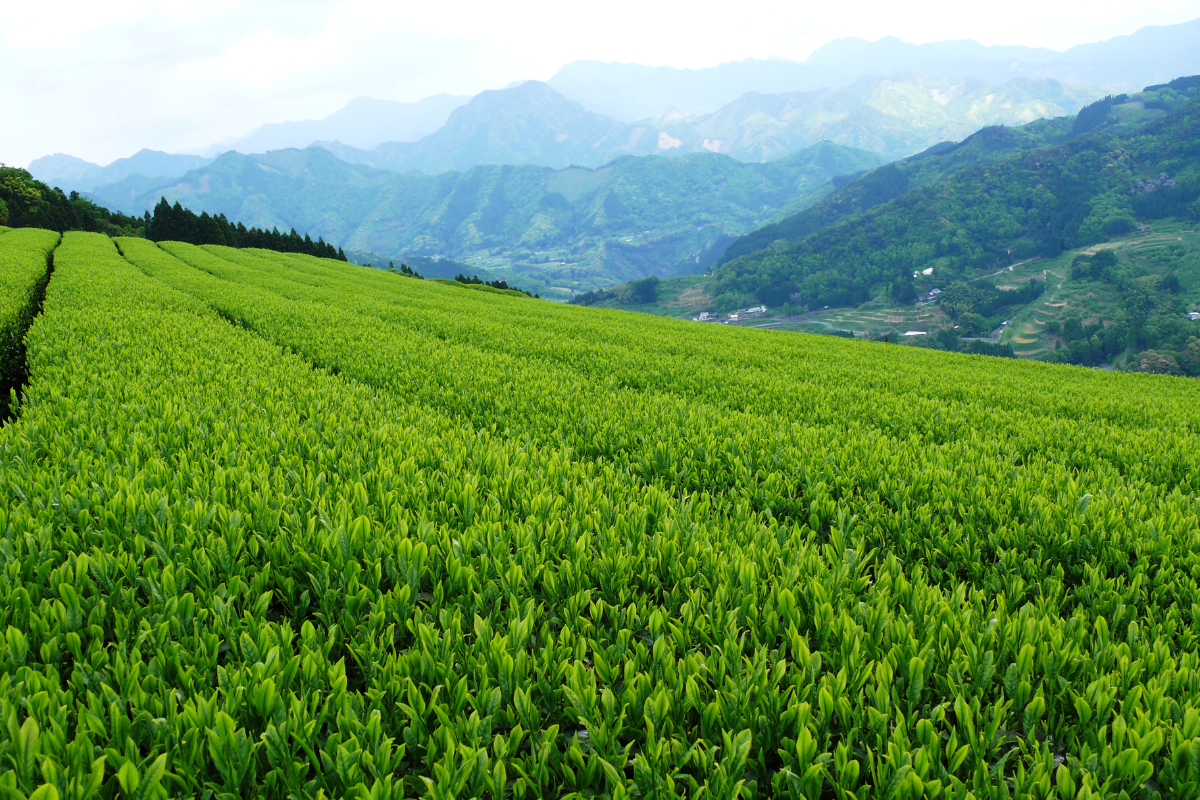
Higashiyama’s tea fields thrive thanks to a rich natural environment. The mountainous terrain, steep slopes, and significant temperature variations, often veiled in morning fog, create ideal conditions for tea cultivation. Here, full-time tea farmers devote themselves entirely to the care of the fields, meticulously managing fertilization and cultivation to ensure the highest quality leaves.
The surrounding landscape is dotted with semi-natural grasslands, home to Japanese silver grass and sasa. Once widespread throughout Japan, these grasslands are now rare, making Higashiyama a haven for biodiversity. Many plants and animals in the area are endangered, highlighting the ecological importance of these traditional landscapes.
The Chagusaba Farming Method: 150 Years of Tradition
For over 150 years, Higashiyama tea farmers have practiced the Chagusaba farming method, a technique that harnesses the richness of semi-natural grasslands. After harvesting autumn bancha tea, farmers carefully cut, dry, and finely chop the grass, spreading it between the tea field furrows. This labor-intensive method:
- Suppresses weeds
- Retains moisture in summer and warmth in winter
- Converts into natural compost, enriching the soil and enhancing tea flavor
- Improves drainage and fertilizer retention, reducing stress on tea plants
The main plant used is Miscanthus sinensis, whose fibers become elastic once broken down, allowing roots to absorb nitrogen efficiently. The result? Tea plants that are healthier and leaves that are large, soft, and thick-fleshed, ideal for the deep-steaming process that brings out sweetness while tempering bitterness.
The Higashiyama Chagusaba covers 130 hectares, nearly matching the tea plantation area of 180 hectares, reflecting the immense dedication of the community.
A Global Recognition
In 2013, the Shizuoka Chagusaba Farming Method was recognized as a Globally Important Agricultural Heritage System (GIAHS) by the Food and Agriculture Organization of the United Nations (FAO). This honour celebrates the balance Higashiyama farmers maintain between preserving biodiversity, traditional farming, and producing world-class tea.
Tea Harvests: Crafting Flavor with Skill
Kakegawa’s tea harvesting is selective. While the first and second harvests are picked, the third and fourth are generally left untouched, with autumn harvests carefully managed. The second harvest is a true test of skill: nature provides bounty for the first harvest, but only through meticulous care during the second harvest can farmers ensure the same rich flavor, aroma, and leaf quality.

The deep-steamed tea produced in Higashiyama is a sensory delight: mellow, sweet, and fragrant, with thick leaves that retain their shape and color, even through roasting. Every sip reflects the commitment, tradition, and passion of the tea farmers who have honed their craft over generations.

%20rises%20gracefully%20over%20the%20Higashiyama%20district,%20spanning%20Kakegawa%20City,%20Kawanehon%20Town,%20Shimada%20City,%20Kikuga...)